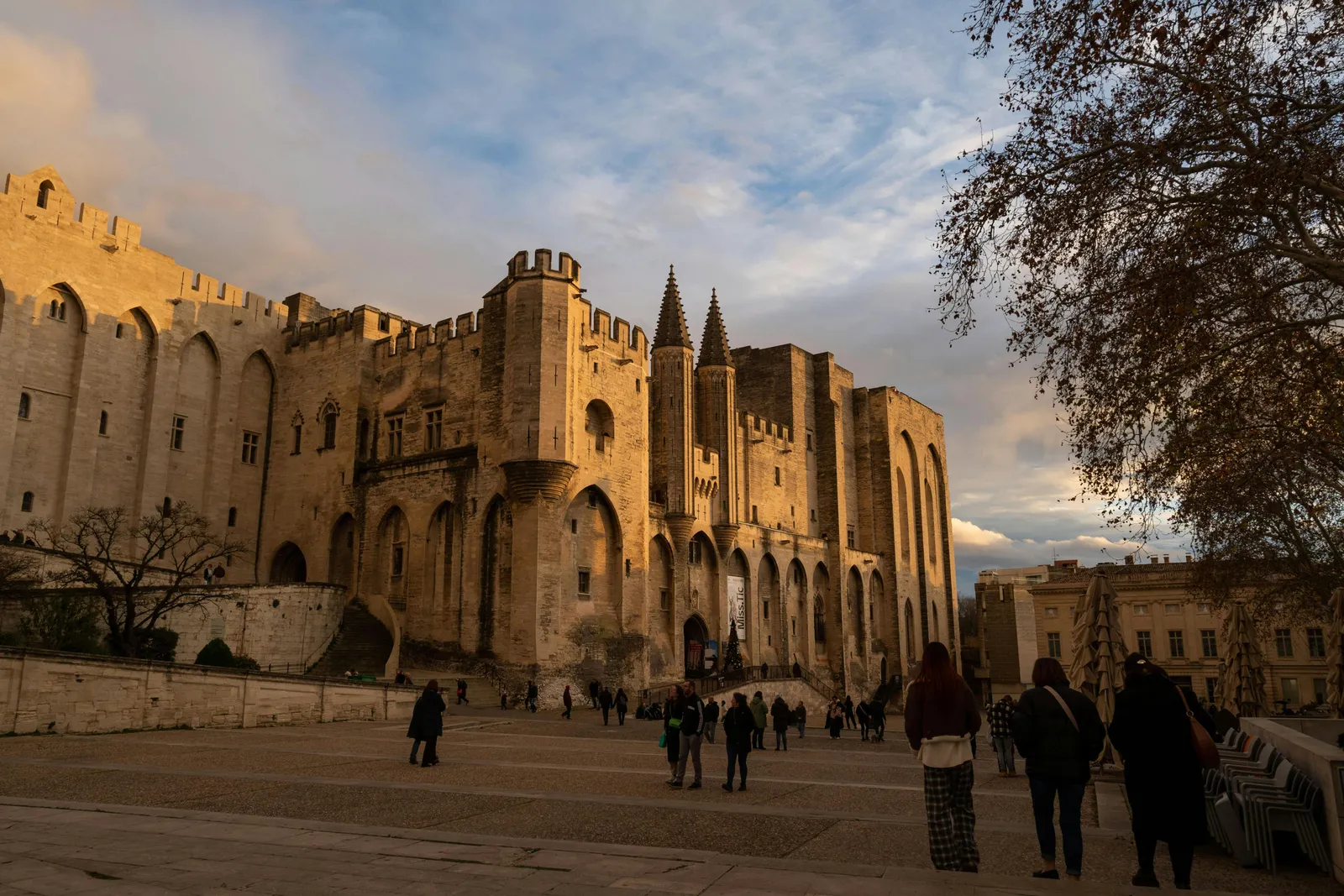
Palais des Papes vs Pont d'Avignon: Which Should You Choose?
A side-by-side concierge comparison of Avignon's two UNESCO-listed flagship monuments — different scales, different stories, and why most visitors should do both.
Avignon is unusual among European heritage cities in that its two most-visited monuments are both UNESCO-listed and both operated by the same public body, Avignon Tourisme. The Palais des Papes is the larger, denser experience — a fourteenth-century papal residence and administrative seat that occupies fifteen thousand square metres and absorbs two to three hours of focused visiting. The Pont Saint-Bénézet, popularly known as the Pont d'Avignon, is a twelfth-century medieval bridge across the Rhône that survives only as a partial structure of four arches and the small Saint-Nicolas chapel, and can be experienced in thirty to forty-five minutes. They are barely four hundred metres apart along the Rocher des Doms ridge. The genuine question, then, is rarely 'palace or bridge' but rather 'palace alone or palace plus bridge', and the answer for most visitors is the combo. This guide compares the two honestly and explains the combination strategy.
Two Monuments, Two Centuries, Two UNESCO Listings
The Palais des Papes was built between 1334 and 1364 across two main construction campaigns: the Palais Vieux (Old Palace) under Pope Benedict XII designed by Pierre Poisson of Mirepoix, and the Palais Neuf (New Palace) under Pope Clement VI designed by Jean de Louvres. It served as the residence and administrative headquarters of the seven popes who lived in Avignon during the so-called Avignon Papacy, when the seat of the Catholic Church was relocated from Rome between 1309 and 1377. At fifteen thousand square metres of floor area it remains one of the largest and most important Gothic palaces in Europe. The Historic Centre of Avignon, including the palace, the episcopal ensemble and the Pont d'Avignon, was inscribed by UNESCO in 1995.
The Pont Saint-Bénézet is older and structurally completely different. According to medieval tradition, the bridge was begun in 1177 under the impulse of a young shepherd named Bénézet, later canonised, who claimed a divine vision instructed him to build a crossing of the Rhône at Avignon. The original twelfth-century bridge had twenty-two arches and ran nearly nine hundred metres across the river. Catastrophic floods in the seventeenth century destroyed most of the structure; only four arches and the small Saint-Nicolas chapel built into one of the piers survive today. The bridge is famous in popular culture for the medieval song 'Sur le pont d'Avignon', which has been taught in French primary schools for generations. Both monuments fall within the same UNESCO listing — they are sister sites, not separate inscriptions.
Scale, Time and What You Actually See
The Palais des Papes is a dense, multi-room experience. The standard visitor circuit covers approximately twenty-five rooms across both palaces, takes two to three hours at a steady pace with the HistoPad tablet that the operator issues with every ticket, and includes Gothic chapels with original Matteo Giovannetti frescoes from the 1340s, the Grand Tinel banqueting hall, the Consistory, the Chambre du Cerf (Stag Room) with its hunting frescoes, the Cour d'Honneur and the terrace viewpoint over the city. The HistoPad provides narrated commentary and augmented-reality reconstructions of how each room looked in the fourteenth century. The experience is structured, immersive and rewards visitors who arrive with some prior interest in medieval history.
The Pont d'Avignon is much shorter and more focused. The visit covers the four surviving arches, the Saint-Nicolas chapel built into the bridge structure, and a small interpretive exhibition explaining the bridge's history, construction and the famous song. Walking out onto the bridge and back, photographing the chapel and the truncated structure jutting halfway into the Rhône, and absorbing the river views to either side typically takes thirty to forty-five minutes. The shorter visit length is not a weakness; the bridge offers a different kind of experience — a single iconic structure absorbed at a contemplative pace, rather than a multi-room walking tour.
The Combo Ticket Reality
Avignon Tourisme, the official operator of both sites, sells a combo ticket that covers both the Palais des Papes and the Pont d'Avignon at a meaningful saving over buying the two tickets separately. The palace-only ticket includes the Pontifical Gardens above the palace, which Avignon Tourisme bundles with palace entry by default. The combo adds the bridge for a modest supplement at operator prices. This pricing structure is deliberate: the operator wants visitors to experience both monuments, and the combo is structured to make doing so the rational choice. Most concierge bookings default to the combo for this reason.
There is a small minority of visitors for whom the palace-only ticket is the better choice: those with limited time who can only spare two hours in Avignon, those visiting in heavy rain when the open bridge is exposed, and those whose interest is specifically in medieval interior architecture rather than the bridge as a cultural icon. For everyone else, the combo is the standard recommendation. It also has a logistical advantage: both sites are operated by Avignon Tourisme staff and the single combined ticket means a single skip-the-line priority entry at each, rather than two separate queuing experiences.
Combining Both in a Single Day
The standard pattern for visitors doing both is the palace first, then the bridge. A morning timed slot at the Palais des Papes between nine-thirty and ten-thirty puts you inside the rooms before mid-day tour groups arrive, allows two and a half hours for the full circuit including the terrace and the Pontifical Gardens, and leaves the early afternoon for lunch in the old town. The bridge is then a thirty-to-forty-five-minute afternoon visit, ideally between two and four when the light over the Rhône photographs well. From the palace you walk north through the Rocher des Doms park, descend the path to the bridge entrance, and exit back into the old town in under an hour total walking time including the bridge visit itself.
The reverse order — bridge first, then palace — works in shoulder seasons when the palace's afternoon slots are uncrowded but is less recommended in peak summer when afternoon palace slots become both hot and busy. A third pattern, particularly popular with photographers, is bridge in the late afternoon for the western light over the river, dinner in the old town, and the palace the following morning. This requires an overnight in Avignon rather than a day-trip from Marseille or another base, but rewards visitors who want unhurried time at both monuments. Concierge services typically pre-secure the combined timed-entry slot so the day flows from one to the next without queueing.
If You Only Have Time for One
Choose the Palais des Papes if you have any prior interest in medieval architecture, Gothic frescoes, papal history, or the broader story of the Avignon Papacy and the Western Schism. The palace is the substantive monument; the bridge is the cultural icon. Visitors with a half-day or less should commit to the palace alone, taking the standard two-and-a-half-hour visit and skipping the bridge with a clean conscience. The palace is also the better wet-weather choice — the entire visitor circuit is indoors apart from the courtyards, which can be skipped if the weather is poor.
Choose the Pont d'Avignon alone only if you genuinely have an hour or less, or if you have visited the palace on a previous trip and want a quick return to the bridge. The bridge is also the better choice for very young children whose attention spans cannot absorb the palace's twenty-five-room circuit; the bridge's compact, open-air format works well for families with toddlers. Visitors with serious mobility constraints may find the bridge more accessible than the palace's multi-level interior, although both monuments have specific accessibility provisions worth checking with Avignon Tourisme in advance. For everyone else, the combo is the rational and recommended answer.
Frequently asked
Are the Palais des Papes and the Pont d'Avignon on the same UNESCO listing?
Yes. Both are part of the Historic Centre of Avignon: Papal Palace, Episcopal Ensemble and Avignon Bridge, inscribed by UNESCO in 1995 as a single cultural heritage site. They are sister monuments under one listing, not two separate inscriptions.
Is the combo ticket worth it?
For most visitors, yes. The combo adds the bridge to the palace ticket for a modest supplement at operator prices, and Avignon Tourisme's pricing is structured to make the combo the rational choice. Palace-only is the right choice only if you have a hard two-hour window or specifically dislike outdoor structures.
How long should I allow for both monuments together?
Allow three and a half to four hours: two and a half to three hours for the palace including the gardens and terrace, plus thirty to forty-five minutes for the bridge, plus walking time between them. Add a lunch break in the old town and you have a full day in Avignon.
Which one is more photogenic?
Different photographers prefer different things. The palace's western facade in late afternoon light is one of the most photographed structures in southern France. The bridge's truncated arches against the Rhône, particularly from the Rocher des Doms park above, is the more compositionally unusual shot.
Are both monuments operated by the same company?
Yes. Both the Palais des Papes and the Pont Saint-Bénézet are operated by Avignon Tourisme on behalf of the City of Avignon. A single ticketing system covers both, and the combo is the operator's recommended option.
Does the bridge actually cross the Rhône?
No, not anymore. Catastrophic flooding in the seventeenth century destroyed eighteen of the original twenty-two arches. Only four arches and the Saint-Nicolas chapel remain, jutting roughly halfway into the river before stopping in mid-channel.
Is the bridge wheelchair accessible?
Partially. The entrance level and the first arch are step-free, but reaching the chapel and the further arches involves uneven stone surfaces. Avignon Tourisme publishes specific accessibility information; contact them in advance for the current arrangements.
Can children dance on the Pont d'Avignon like in the song?
The bridge surface is open and walkable, so children can certainly recreate the famous song's image. The bridge's historical reality is more prosaic — medieval bridges in this region were primarily working crossings, and the song's dancing reference likely conflates the bridge with the island below where festivities took place.
Which one is better in bad weather?
The palace, decisively. Most of its visitor circuit is indoors, and the medieval interiors are unaffected by rain or mistral wind. The bridge is fully exposed and the Saint-Nicolas chapel is open at both ends, offering limited shelter.
Can I see the bridge from the palace without visiting it?
Yes. The palace's terrace viewpoint over the old town offers a clear view down to the Rhône and the surviving arches of the bridge. The Rocher des Doms park between the two also delivers an elevated panorama of the bridge from above.