← Back to Papal Palace Tickets home
The Gothic vault of the Grand Tinel banqueting hall at the Palais des Papes

What to See Inside the Palais des Papes: A Room-by-Room Guide

From the Grand Tinel's forty-eight-metre banqueting hall to the Chambre du Cerf's hunting frescoes and the Giovannetti chapels — what to look for in every part of the palace.

Updated May 2026 · Papal Palace Tickets Concierge Team

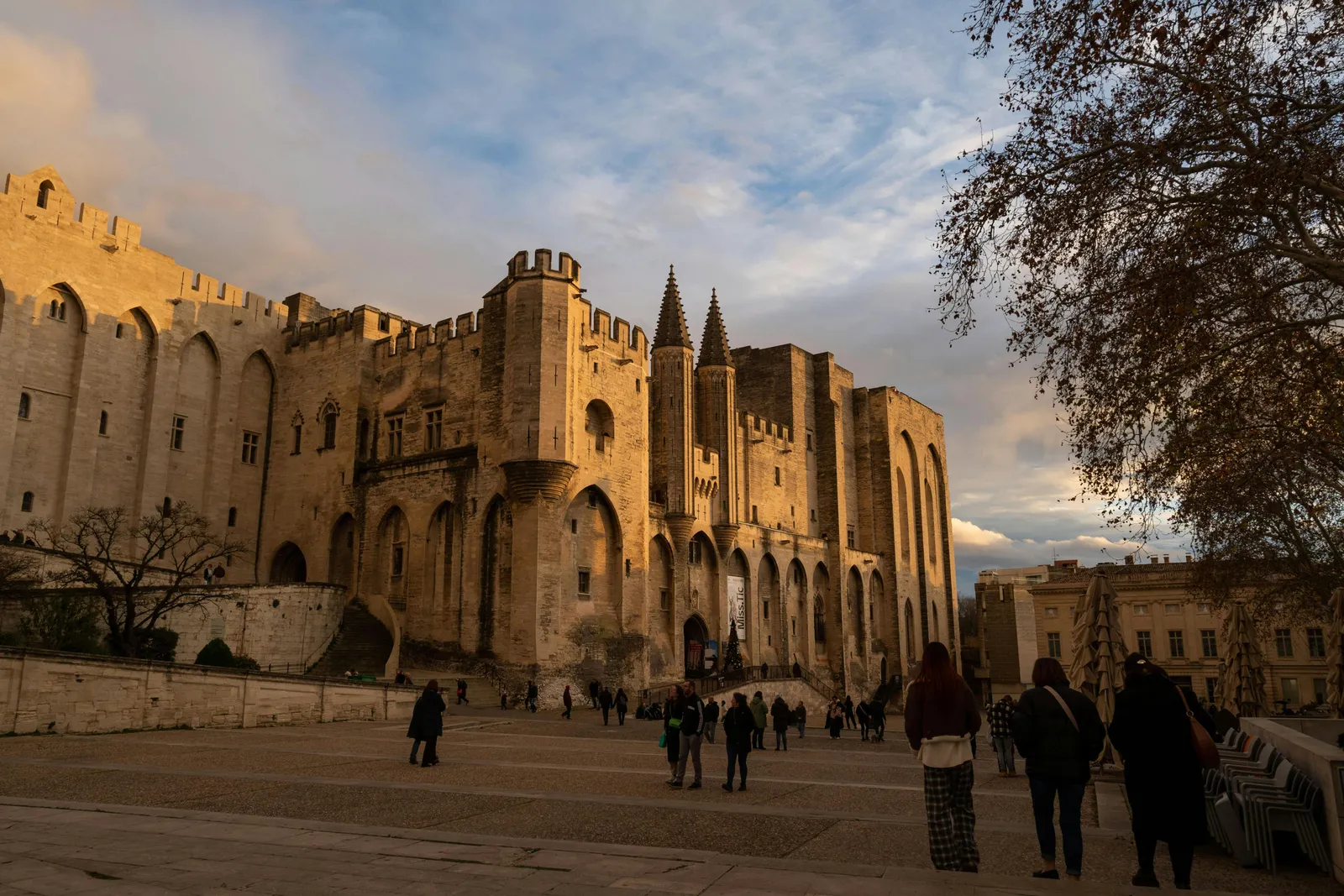
The Palais des Papes is built on a scale that surprises first-time visitors. Across fifteen thousand square metres of floor area, two interconnected palaces — the austere Cistercian-influenced Palais Vieux built under Benedict XII and the more decorative Palais Neuf built under Clement VI — combine more than twenty-five rooms in a one-way visitor circuit that takes between two and three hours to walk at a steady pace. The interior was largely stripped during the French Revolution, when the palace was converted first into a prison and later into a barracks; many original furnishings and tapestries did not survive. What remains is the architecture itself — the soaring Gothic vaults, the original Matteo Giovannetti frescoes in two chapels, and the few decorated private rooms that escaped destruction. The HistoPad tablet issued with every ticket uses augmented reality to reconstruct how each room looked in the 1340s, which transforms what could be a series of bare stone halls into a vivid medieval experience. This guide walks through the principal rooms in the order most visitors encounter them.

The Cour d'Honneur and the Entrance Sequence

The visitor circuit begins in the Cour d'Honneur, the great inner courtyard between the Old Palace and the New Palace. This is the same courtyard that the Festival d'Avignon uses as its main stage every July, and the scale alone — flanked by Gothic facades on all four sides — sets the tone for what follows. From here you climb the wide stone staircase to the upper floor of the Palais Vieux, passing through the Consistory antechamber and into the rooms used for papal administration. The HistoPad reconstructions of the Cour d'Honneur show it covered with awnings, banners and the assembled papal household for ceremonial occasions; today the empty space lets the architecture speak for itself.

Security and ticket scanning happen at the main entrance on the Place du Palais before you reach the courtyard. Visitors with priority skip-the-line tickets go to the dedicated lane, have their QR code scanned, pass through the bag check, and pick up a HistoPad tablet from the desk just inside the building. The HistoPad is available in eleven languages and replaces the older audio-guide system entirely. For visitors who prefer audio-only, Avignon Tourisme also offers a 'Les Clefs du Palais' WebApp downloadable to your own phone in six languages. Both options are included with the standard ticket and there is no separate audio-guide product to purchase.

The Consistory and the Saint-Jean Chapel

The Consistory is the audience hall where the College of Cardinals met to advise the pope on administrative and judicial matters. The room is rectangular, lofty, and originally hung with tapestries and frescoes that were destroyed during the Revolution; today it is austere stone, with the HistoPad overlay showing how the original decoration covered every wall. This is the room in which papal elections were held when conclaves convened in Avignon, including the elections of Clement VI in 1342 and Innocent VI in 1352. Standing in the empty space and reading the HistoPad commentary, the scale of medieval ecclesiastical power becomes intuitive in a way that text descriptions cannot match.

Adjacent to the Consistory is the Saint-Jean Chapel, the lower of the two Giovannetti chapels and the more frequently overlooked. The Italian painter Matteo Giovannetti, originally from Viterbo and trained in the Sienese tradition under Simone Martini, executed the chapel's frescoes between 1347 and 1348. The cycle depicts scenes from the lives of John the Baptist and John the Evangelist in a refined Italianate style that influenced French painting for decades after. Much of the original colour has darkened with age, but the compositions remain legible and conservation work continues regularly. The chapel's modest size — it is built into the base of the Saint-Jean tower — concentrates the visual impact; visitors who pause here for five minutes rather than walking through typically rate it as a highlight of the visit.

The Grand Tinel and the Saint-Martial Chapel

The Grand Tinel is the great banqueting hall, forty-eight metres long and one of the largest medieval reception rooms in Europe. It was used for state banquets, papal coronation feasts and large diplomatic receptions during the Avignon Papacy. The chestnut-wood ceiling is reconstructed but follows the original medieval profile, and the scale of the space — particularly when entered after the more enclosed Consistory and chapels — produces the strongest single 'wow' moment in the standard visitor circuit. HistoPad reconstructions show the hall set for a coronation banquet, with long tables, hangings, and the elaborate table service that the Avignon court was famous for.

Above the Grand Tinel, reached by a short staircase, is the Saint-Martial Chapel — the second Giovannetti chapel and the better-preserved of the two. The frescoes here, executed between 1344 and 1345, depict scenes from the life of Saint Martial, the third-century bishop of Limoges and an important figure in French church history particularly venerated by Clement VI, who came from the Limousin region. The chapel's colour palette has survived noticeably better than that of Saint-Jean below, with deep blues, terracottas and gold leaf still legible. For visitors interested in fourteenth-century painting, the two chapels together represent the most important Italian-influenced fresco cycle north of the Alps from this period.

The Chambre du Cerf and the Pope's Private Apartments

The Chambre du Cerf, or Stag Room, is Clement VI's private study, located in the tower of the same name and decorated between 1343 and 1345 with secular hunting and fishing frescoes — an unusual subject choice for a papal chamber and a vivid window into the personal taste of the pope who turned Avignon into a Renaissance-style court more than a century before the Italian Renaissance proper. The frescoes depict young men hunting deer, fishing in ponds, training falcons and picking fruit, all set in a stylised garden landscape with detailed flora and small animals. The painting is attributed to Matteo Giovannetti and his workshop, though some scholars argue for a separate hand on the secular subjects.

The Chambre du Cerf is the single most surprising room in the palace for most visitors. After the austere ecclesiastical spaces and the great banqueting hall, the playful, almost domestic intimacy of the hunting frescoes produces a sharp tonal shift. The room is small — Clement VI used it as a private study and informal audience space — and the frescoes wrap continuously around the walls, surrounding the visitor with a coherent decorative programme that survives almost intact. This is one of the rooms where photography (without flash) is most rewarding. Adjacent rooms in the pope's private apartments are less decorated but the HistoPad reconstructions are particularly effective here in showing the original sumptuous furnishings.

The Terrace, the Treasury and the Pontifical Gardens

The visitor circuit climbs progressively to the terrace viewpoint at the upper level of the New Palace, which offers a panoramic outlook across the walled old town, the Rhône, the Pont d'Avignon and the surrounding Provençal landscape stretching to the Mont Ventoux on clear days. The terrace is the photographic highlight of the visit for many visitors and is also one of the few open-air spaces in the circuit where the mistral can become noticeable in cooler months. Allow fifteen to twenty minutes here; the views are different in every direction and the height above the Place du Palais — roughly fifty metres — places you above the rooftops of the entire old town.

The Treasury, located in the lower levels of the Tour des Anges in the older Palais Vieux, originally held the papal financial reserves, archives and precious objects. The vaulted rooms now display interpretive material about medieval papal finance and the administration of the Apostolic Chamber, the treasury body that managed papal income from the entire western Christian world. The Pontifical Gardens above the palace, included with the standard ticket and bundled with palace entry by default, occupy the terraced slope between the palace and the old city wall, and are a quieter end-of-circuit space for visitors who want to decompress after the dense interior visit. From the gardens, a path leads down to the Rocher des Doms park and onward to the Pont d'Avignon.

Frequently asked

How long does the interior visit take?

The standard one-way circuit through the palace interior takes two to three hours at a steady pace with the HistoPad. Visitors who slow down for the Grand Tinel, the Chambre du Cerf and the two Giovannetti chapels often spend closer to three and a half hours including the terrace and the Pontifical Gardens.

Is the HistoPad really worth using?

Yes, emphatically. The palace interior was largely stripped during the Revolution, so the bare stone walls do not communicate the original ceremonial atmosphere. The HistoPad's augmented-reality overlays reconstruct each room as it looked in the 1340s and transform the visit from architectural to immersive.

Can I take photographs inside the palace?

Yes, handheld photography without flash is permitted throughout the interior. Tripods, monopods and flash are not allowed. Some conservation-sensitive areas around the Giovannetti chapels may have additional signage requesting no photography on specific days.

Which is the most impressive single room?

Opinions vary, but the Grand Tinel for sheer scale and the Chambre du Cerf for decorative survival are the two most frequently cited. The Saint-Martial Chapel above the Tinel is the strongest specialist favourite for visitors interested in fourteenth-century painting.

Are the Giovannetti frescoes the originals?

Yes. The frescoes in both the Saint-Jean and Saint-Martial chapels are original fourteenth-century work executed by Matteo Giovannetti and his workshop between 1344 and 1348. Conservation has stabilised them but the painting is largely as Giovannetti left it, with the expected darkening of pigments over seven centuries.

Is the terrace included with all tickets?

Yes. The terrace viewpoint is part of the standard visitor circuit and is included in both the palace-only ticket and the combo ticket with the Pont d'Avignon. The Pontifical Gardens are also bundled by default with palace entry.

Are guided tours available inside the palace?

Avignon Tourisme offers scheduled guided tours in French and English at peak times, and private guides licensed by the regional tourist office can accompany visitors on standard tickets. The HistoPad-led self-guided visit is the most common pattern and works well for visitors comfortable navigating independently.

Is the interior accessible for limited mobility?

The palace was built in the fourteenth century on a sloping site and the visitor circuit includes multiple staircases between levels. A limited accessible route covers some of the principal ground-floor rooms; contact Avignon Tourisme in advance for the current arrangements and to plan a tailored visit.

What survived the Revolution and what didn't?

The architecture — vaults, walls, towers, courtyards — survived almost entirely intact. Most movable decoration, tapestries, furniture and gilded fittings did not. The Giovannetti chapel frescoes survived because they are fixed plaster painting; the Chambre du Cerf survived similarly. Most other rooms are now stripped stone with HistoPad-reconstructed overlays.

Can I see the room where popes were elected?

Yes. The Consistory hosted papal elections during the Avignon Papacy, including the conclaves that elected Clement VI in 1342 and Innocent VI in 1352. The room is on the standard visitor circuit and the HistoPad explains the election procedure in detail.